Tafar Chia Lewis’ one-woman show, God Save The Queen, is a theatrical journey from Trinidad to Europe and back, via a route of colonial history, cultural imperialism, politics of identity and self discovery in the Arts. In this piece, Lewis’ autobiographical narrative is told through a character by the name of Legacy, who is guided by Sargassum Seaweed on her pursuit of a foreign education in the performing arts. Set during the global pandemic, Legacy confronts racial identity, microaggression and systemic racism – all combatted by her Caribbean cultural confidence as she navigates her new environment.
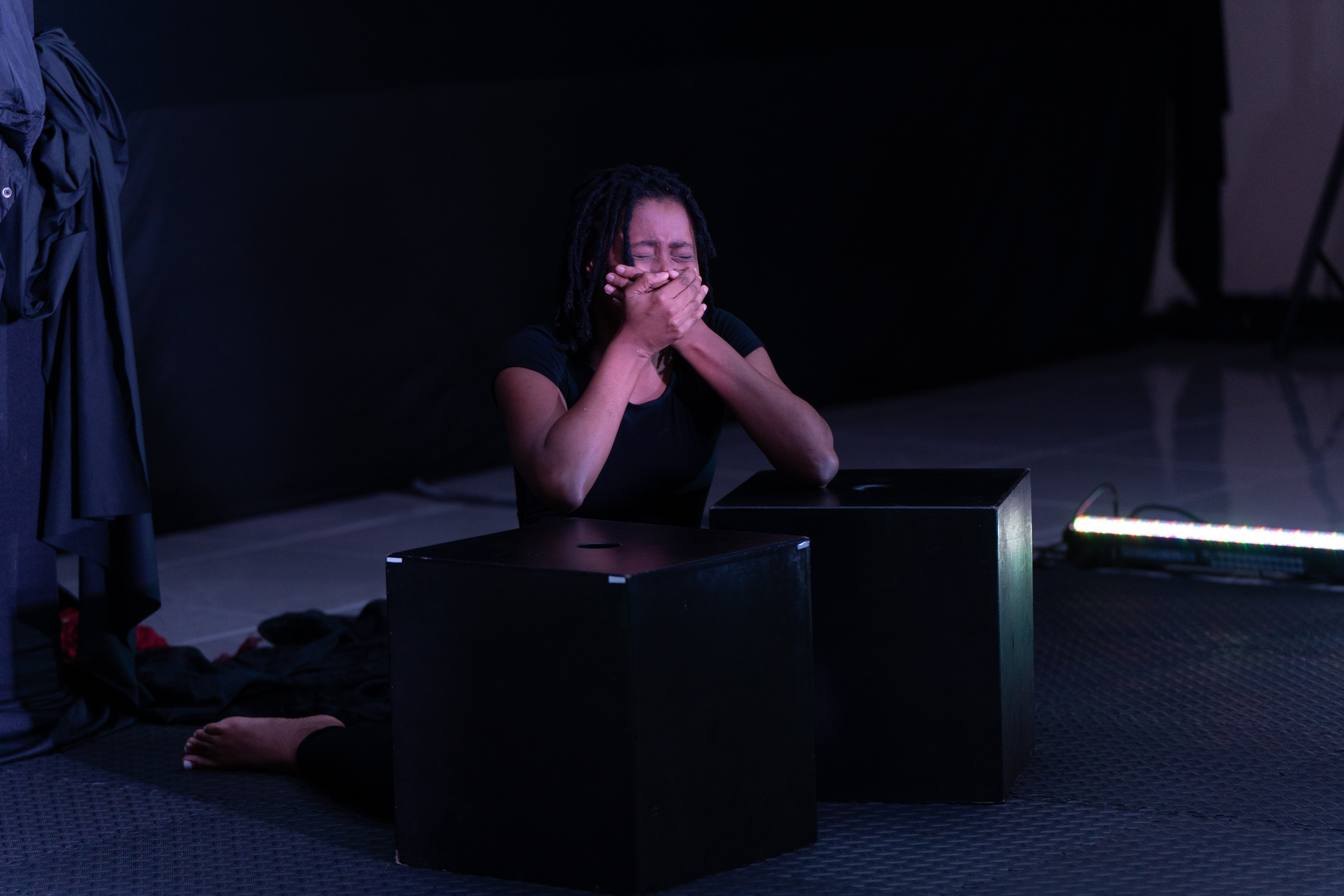
This piece was developed during Tafar’s residency at the Norwegian Theatre Academy and performed at the Royal Conservatoire of Scotland as part of their Master of Fine Arts programme – where she was the only black student and first Caribbean artist to have been enrolled in the exclusive and competitive space. Two years later, the artist has brought it back home to be performed at the UWI’s Social Sciences Lounge, 26th – 28th July, 2024. This review covers the final performance.
I was immediately excited and intrigued by this production, foremost for its incredible bravery as an undertaking. It offers the local theatre community an excellent opportunity to experience something far beyond the ordinary, showcasing both high-quality performances and out-of-the-box concepts from European conservatoire programmes. As someone who made a similar journey from Trinidadian student to international student in a European conservatoire programme – facing visa challenges, homesickness, culture shock and all the like- there was much of her story that resonated deeply with me and lowkey awakened some post-traumatic stress.
God Save The Queen is a striking multimedia performance – with credits due to Jr Soy productions for supporting audio and video. The most commendable element was the sound effects which took the audience to different settings: the eerie virtual world of COVID-19, the buzzing tension of an airplane, or the chaos of a taxi ride. However, there was one moment that felt slightly disjointed—a scene with a ticket hostess on a train where the timing between the sound bites and reactions was a bit off, making the scene feel jerky. Despite this, the performance effectively used projections and interactive elements, drawing the audience further into her journey.

Lewis also used multimedia to carry us back to her home in Maloney, and encourages an interactive element where the audience reads off of slides projected. There was never a dull moment as the audience was always on their toes and given much opportunity to be part of the unfolding of events-even lighting a fake candle in the darkness of the space at one point.

The performance took place in a non-purpose-built space at the UWI campus, yet Tafar transformed the social sciences lounge into a versatile stage. Her minimalist set design worked perfectly, allowing the audience to imagine dozens of different locations, which is ideal for this kind of intimate black-box theatre that relies on the actor’s ability to shift the narrative landscape.
One of the elements I deeply admire about Tafar is how she navigates her classical training while retaining the authenticity of Trinbagonian speech. Even when reciting Shakespearean verse, her tongue is that of a Trini- and not the uptown prestige school kind. This ability to blend both worlds speaks volumes about the persistence of identity in spaces that can often be overwhelming or alienating—especially within post-colonial and neo-colonial structures.
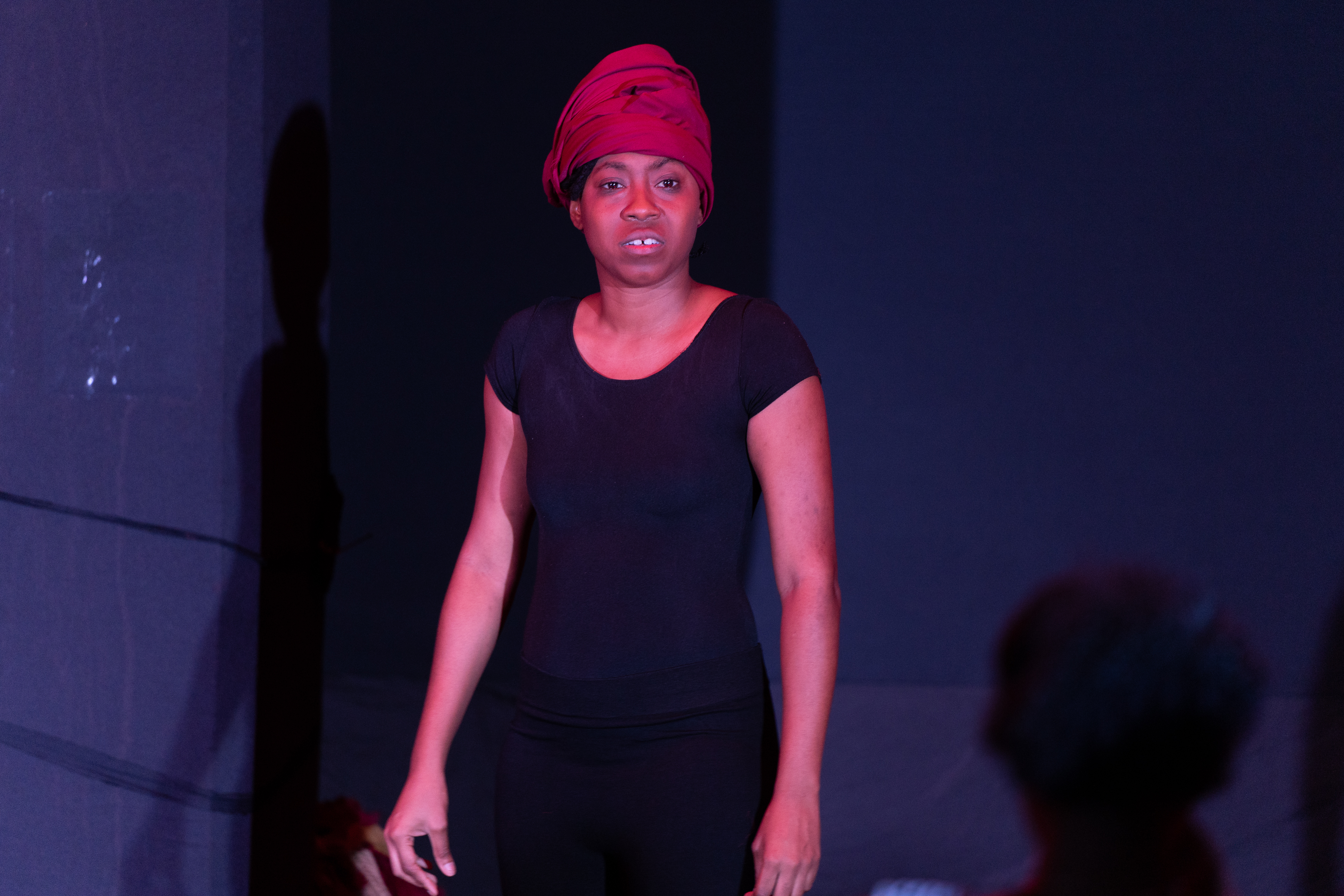
The script is what I would describe as capricious. Whether intentionally or not, it truly captures the erratic nature of an artist’s internal monologue, particularly when grappling with displacement and cultural identity. It felt unpredictable, as if we were never sure what would come next—mirroring the chaotic nature of self-discovery. Yet, I did wish for stronger connections between the scenes, as it sometimes felt difficult to track the narrative’s throughline. Her reflection on African heritage, for instance, was introduced as a powerful turning point but was not fully explored or integrated into the overall story. In fact, my one major critique lies in the depth of the narrative. There were moments where I wanted Tafar to dig deeper into certain themes and go beyond verbatim repetition and reporting of events, exchanges of words and thoughts. While Tafar’s storytelling is strong, I found myself wishing for more poetry or poetic devices to extend metaphors and paint verbal pictures without always having to ‘tell it like it is’.
The audience turnout for God Save The Queen was heartwarming, showing the community’s support for this kind of experimental theatre. Offering student rates was a wonderful decision, making this crucial work accessible to the next generation of theatre-makers.

Tafar’s boldness in tackling such complex and deeply personal themes deserves high praise, and her work undoubtedly inspires both thought and reflection. God Save The Queen certainly pushes the boundaries of what we expect from Caribbean theatre.
Note: Reviews are editorially independent and reflect the informed perspective of the assigned writer. Submissions may be edited for clarity, coherence, and publication standards without altering the reviewer’s original viewpoint.
ABOUT THE AUTHOR

Harmony Farrell (also known as @hotfootharmony) is a multidimensional creative, with a strong background in media and the performing arts, with a keen focus on Caribbean culture. She is a writer, digital content producer and creator, theatre performer, dancer, published academic researcher and carnival enthusiast. Harmony was recipient of the first ever NGC Bocas Youth Writer Award in 2021, based on her theatre reviews and blog posts on contemporary social commentary. With a BA in Theatre and Performance with Creative Writing from the Guildford School of Acting/University of Surrey, Harmony’s approach to all work is situated between her scholarly inclinations and her practitioner’s insight in the arts, culture and media. At present, she is an MA student in the Cultural Studies programme at The University of the West Indies, St. Augustine. Her Masters thesis is groundbreaking in its uniting of digital culture with carnival/festival studies.
 The Trinidad and Tobago Performing Arts Network