
Note: Reviews are editorially independent and reflect the informed perspective of the assigned writer. Submissions may be edited for clarity, coherence, and publication standards without altering the reviewer’s original viewpoint.
In Derek Walcott’s “Pantomime”, he suggests the idea of a ‘creole method’ of acting which distinguishes itself from the western classical style. Staged at the Central Bank Auditorium on February 28th (opening week), RS/RR Productions’ “Scandal in Cedros” presents itself as a showcase of the exact style of uniquely Caribbean exaggeration, mannerism and storytelling born from the melting pot of the region. In both its successes and flaws, the play is an honest and excitable presentation of contemporary Trinidad and Tobago, which seeks to parody and accentuate the culture with larger-than-life and often absurd humour. The show’s success is found when it dares to take risks, and make bold choices, as compared to the less inspired moments when it takes aim at the low hanging fruit.
The plot follows a dynamic set of characters made up of Tina (Debra Bocaud Mason), the housemaid, the husband and wife – Calvin (Richard Ragoobarsingh) and Vanessa (Zo Mari Tanker), Walter (Kern Samuel), Calvin’s business partner, Damien (Nicholas Subero), Walter’s accountant, Mr. Beharry (Arnold ‘Pinny’ Goindhan), a random taxi driver, and Paloma (Benita Wilson), Calvin’s mistress (scandalous right), inside of a beach house in Cedros. The play launches into full throttle from the get-go, with drug handling calls, sketchy movements, murder, madness and, strangely enough, a sucka-bag factory in Icacos at the forefront. Throughout the runtime, egos are shattered, lies grow until they crumble upon themselves and all the secrets are revealed.
Generally, the technical elements are well thought out and exciting: dynamic lighting, excellent sound design and eye-catching set pieces. The set is designed in a manner that feels inviting and intimate, the cross section of the Cedros house by the shore keeps all the action just close enough for the audience to feel involved as a proverbial ‘fly on the wall’. The frankly immense amount of alcohol inside of the bar feels almost like a fore-warning for the frantic pacing and continuously building tension. The set furnishings by Fens of T&T is particularly great, the stage truly feels like a quaint getaway home for an upper class couple and helps immensely in grounding the more bizarre elements of the production.

The most notable element of the production is certainly the script. Ricardo Samuel’s wit and understanding of Trinidadian culture shines through, with line deliveries and running gags that fire at an incessant pace. However, this constant drive for humour often seems to come at the expense of the above actual progression in the story, and when a joke or idea doesn’t land, it drags heavily. Some scenes felt like a character repeating the same punchline or plot detail well beyond its comedic peak. Characters would leave the main stage and come back on only to repeat the exact same thing in a different manner, which leads one to question what was the purpose of certain lines.
At the same time, the willingness to continually up the ante in the zaniness does yield some strong results. There are several moments in this comedy that are so inventive that it might make one jealous that they could not even conceive of a gag that bizarre. From Tina’s constantly shifting story of how she first got employed, Calvin’s almost pathological lying and especially Paloma (Benita Wilson) in the most hilarious scene where you will Wonder whether there has ever been a Woman that funny in anything that you’ve seen. The shining moments of the play are almost always when wit and playfulness are placed above the pursuit of cheap laughs, shock value or unnecessary vulgarity.
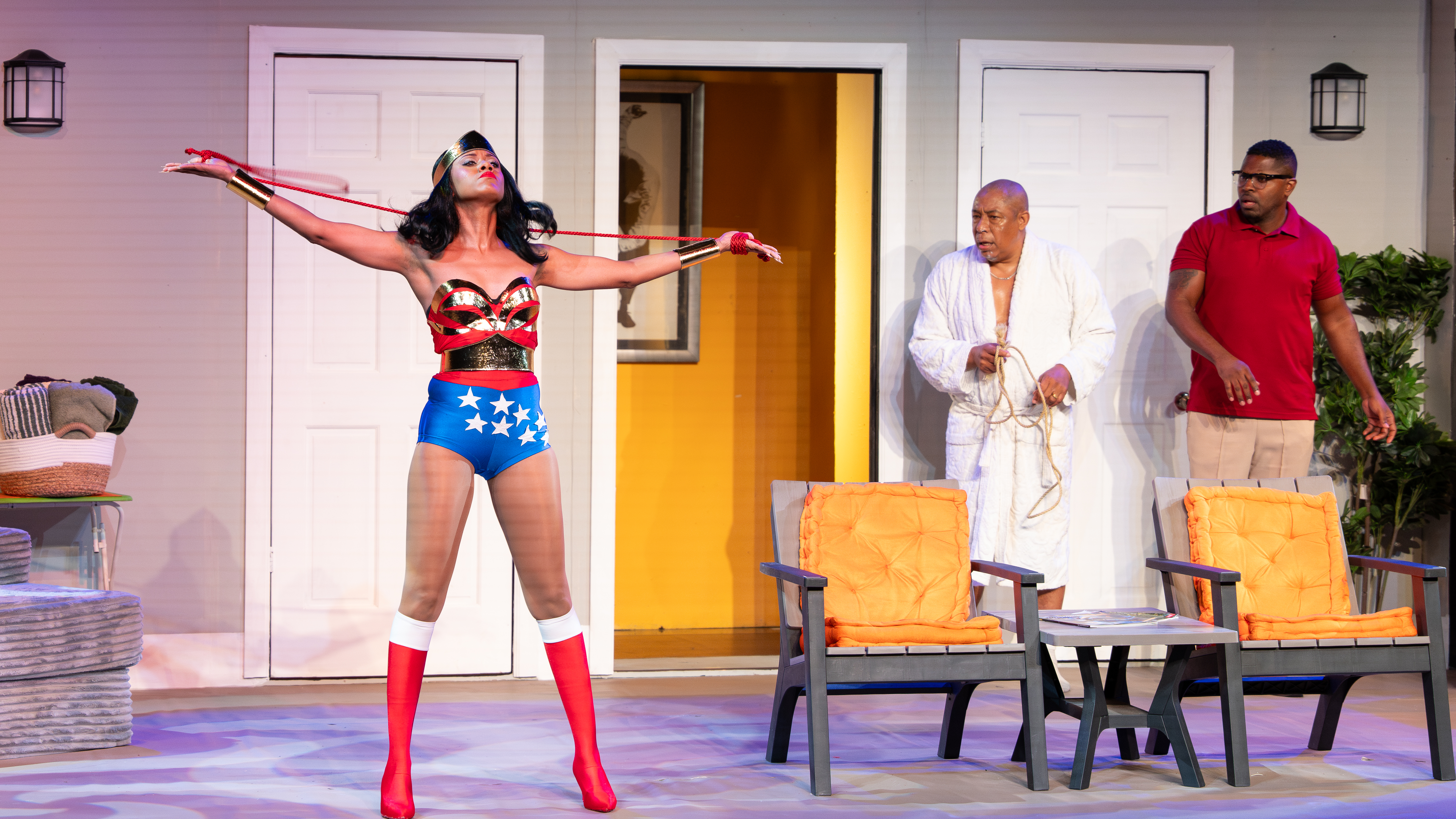
Still, the use of vulgarity and less savoury aspects of society is part of the very identity of this “Scandal”. The mischievous old Mr. Beharry (Arnold Goindhan) is a perfect example; he is a crass, old-timer, country bumpkin taxi driver that endears himself to the audience as a more relatable voice among all the rest of this madhouse. In not being afraid to showcase things that many may consider negative or taboo elements of society, there are some poignant moments of political and social commentary which left the audience in a raucous laughter.
Be it the censorship of artists, politicians speaking in riddles or most importantly the relationship between Trinidad and Tobago with her next door neighbour, Venezuela, this piece of work feels very timely. That said, the provocateur style of the show doesn’t always work in its favour. There are some unfortunately misogynistic and racially insensitive elements of the writing and portrayal of Vanessa and Paloma which can leave an unpleasant taste in your mouth. While the actors bring commitment and genuine comedic value to their roles, it’s unfortunate that a show so willing to be counter-culture still falls victim to more pedestrian conventions such as stereotype driven humour.
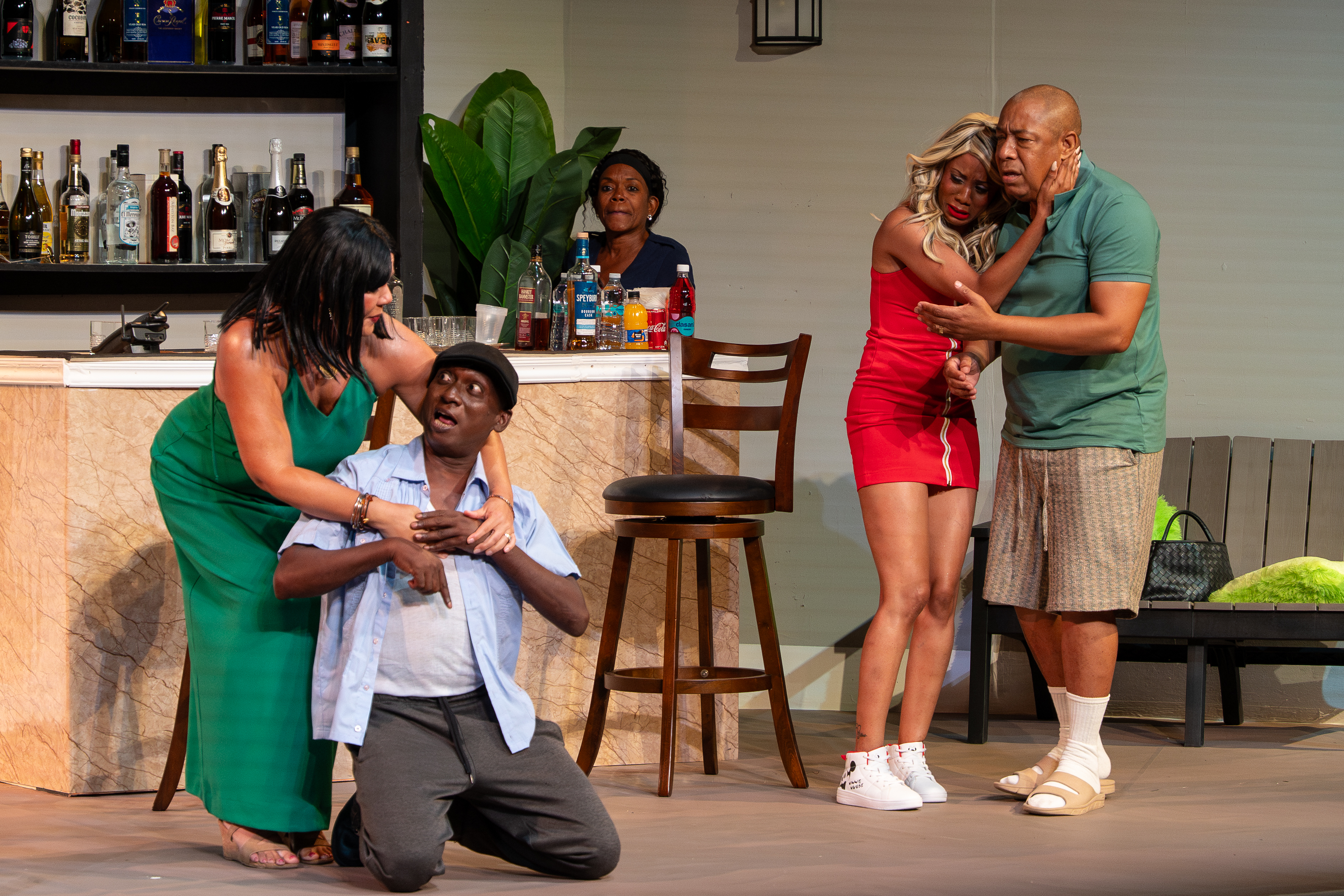
Photo credit: Saul Ramlal
In the first half of the production, scenes are divided quite strangely as some may seem to go on for way too long, while in others lights would fade to black on random lines of dialogue which did not appear to be the bookend of the scene. The mystique and questions raised by the bizarre happenings of the script are well established, though it can also feel extremely heavy on exposition. There is a lot to explain about the situation that everyone is in, but characters often go off on tirades that do little to characterise them further and only serve to comment on what just happened in the scene or inform the audience of what will happen next.
The good thing is that even these lines are so packed with jokes that one often forgets that they’re just being explained things. As the play reaches closer to the climax and dénouement, the pace of action increases but so too does the amount of things going on. It seems like entire plot points end up being forgotten for the longest period of time, with the most important plot point (habeas corpus) being ignored for almost the entire play.
Referring to Pantomime in my opening paragraph was not merely used as a hook, it was also a purposeful framing device. as “Scandal in Cedros” perfectly demonstrates the distinction that was being made in Walcott’s work about the Creole and classical styles of performance. The creole drama is one that is characterised by having various influences, being carnivalesque and often valuing exaggeration over verisimilitude.

Yet the setting and style of this play is strangely classic – only taking place in one location, over the course of about a day. What separates this production is the way that it maneuvers through, and ultimately disrupts, this rigid structure. Debra Boucaud Mason and Richard Ragoobarsingh’s directing choses to employ the big movement and bacchanal that is common in Caribbean work over the subtlety or ‘realism’ of Western style. These intentional ‘creole’ elements, constitute an acting style that seeks not only to entertain, but also to satirise, dramatise and sensitise with spectacle and fun.
This approach is made even more effective by the strength of the performances, which were overall excellent. Debra Bocaud Mason was a standout as Tina. She balances zaniness, level-headedness, humour, deception and has one of the most interesting twists in the entire show. She floated on the stage with her beyond perfect comedic timing, willingness to use her whole physicality in her characterisation and she somehow makes Tina’s character work in all the various roles that she takes on over the course of the story.
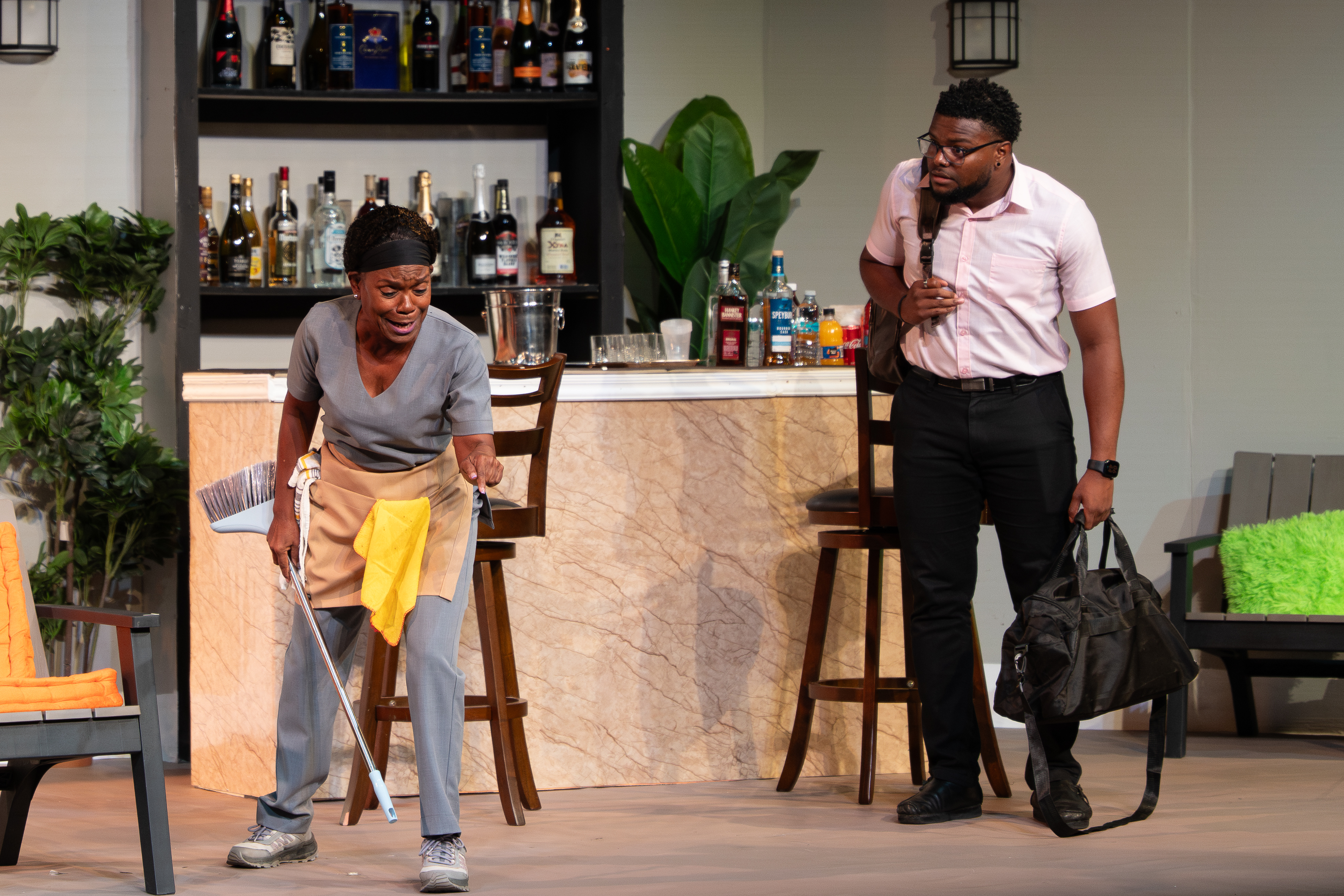
Arnold Goindhan and Benita Wilson’s performances also gave solid performances in their supporting roles. Even though they were not the most instrumental to the goings-on of the story, almost every moment with them onstage was a delight and they offered a unique breath of fresh comedic energy that complements the ensemble cast. Kern Samuel as Walter subverted my expectations. When we are first introduced to him, he presents himself as far too “normal” for the situation that is unfolding making him not as interesting to follow. But this was purposeful to conceal himself in sheep’s clothing. A choice which paid off in dividends by the second half.
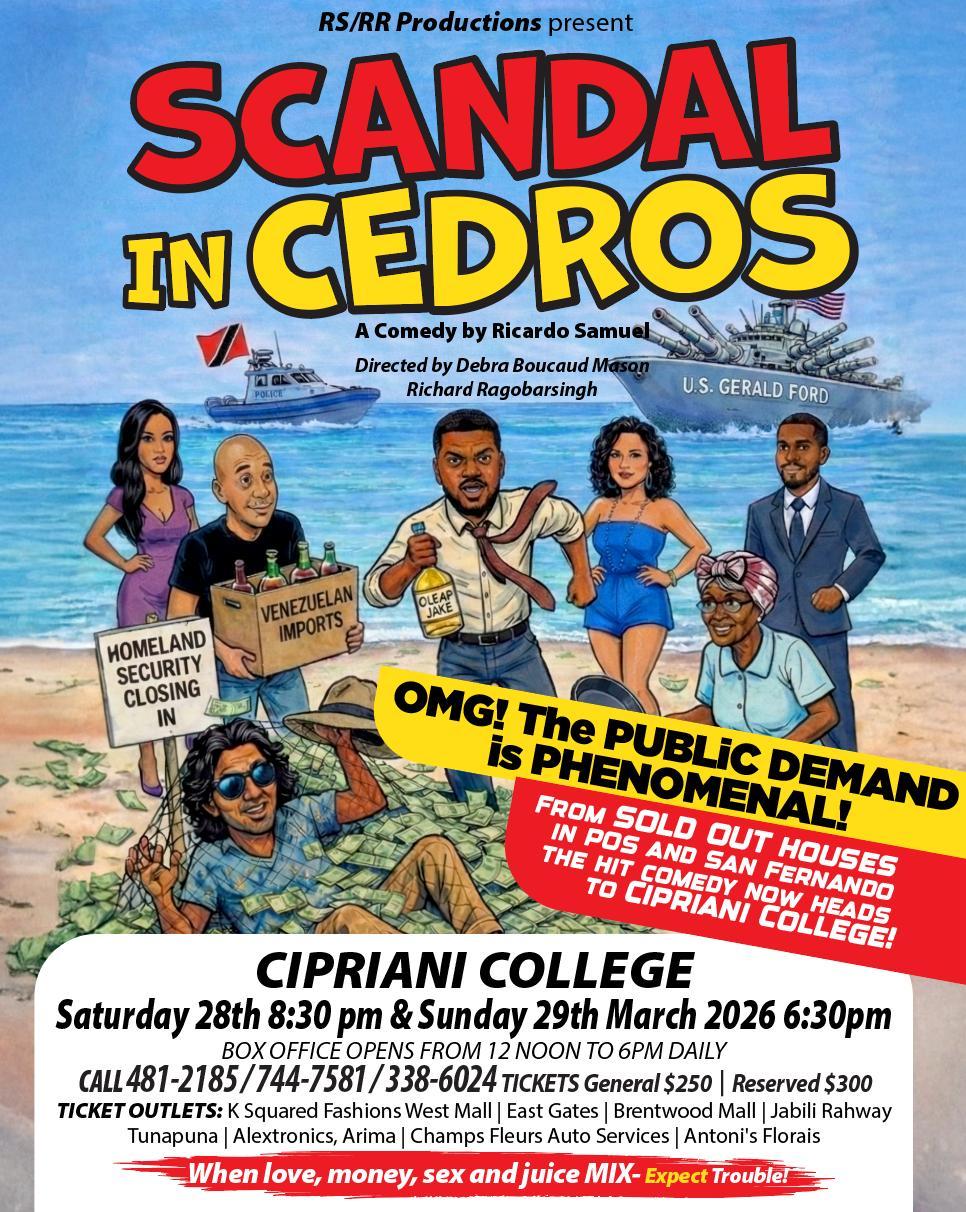
While the production value of the show was definitely a highlight, the decision to use an A.I. generated poster for the promotional material, has the unfortunate consequence of cheapening the brand, and doesn’t represent the clear amount of passion and energy that went into staging this work It is ironic though that the script itself includes jokes at the expense of A.I., while simultaneously employing its use behind the scenes to promote the work.
Ultimately, “Scandal in Cedros” is a wonderfully zany reflection of Trinidad in the middle years of the 2020’s at its best, and a sometimes confusingly plain comedy at its worst. It is an absolute riot, with 100 laughs per minute or more, but the small grievances with its writing style and production choices keep it from realising its full potential. Nonetheless, It’s a great viewing experience and recommendable to anyone interested.
RS/RR Productions “Scandal In Cedros” continues March 28th – 29th at Cipriani College.
Copyright Notice: All photographs published in this review were taken by Saul Ramlal for the Trinidad and Tobago Performing Arts Network. These images may be shared on social media for non-commercial purposes only, provided they are properly credited and a link to the original review is included. For use on other websites, in print, or for any commercial purposes, please contact us directly for permission/licensing.
ABOUT THE AUTHOR

 The Trinidad and Tobago Performing Arts Network