Dilapidated walls house a compilation of broken and discarded items – furniture, futures, Jean and Dinah. Penned almost three decades ago, Tony Hall’s “Jean and Dinah” offers a poignant commentary on the plight of women fighting to survive and the cyclical nature of their experiences and adversities. It is material that unlocks the multifaceted nature of misogyny and the effects of colonialism. The spine chilling exploration of trauma, abuse and exploitation in this tragi-comedy pushes audiences to the brink, only giving respite by way of raw, unfiltered humor. The play mirrors an unpleasant reality, one that women have and continue to face decades later.
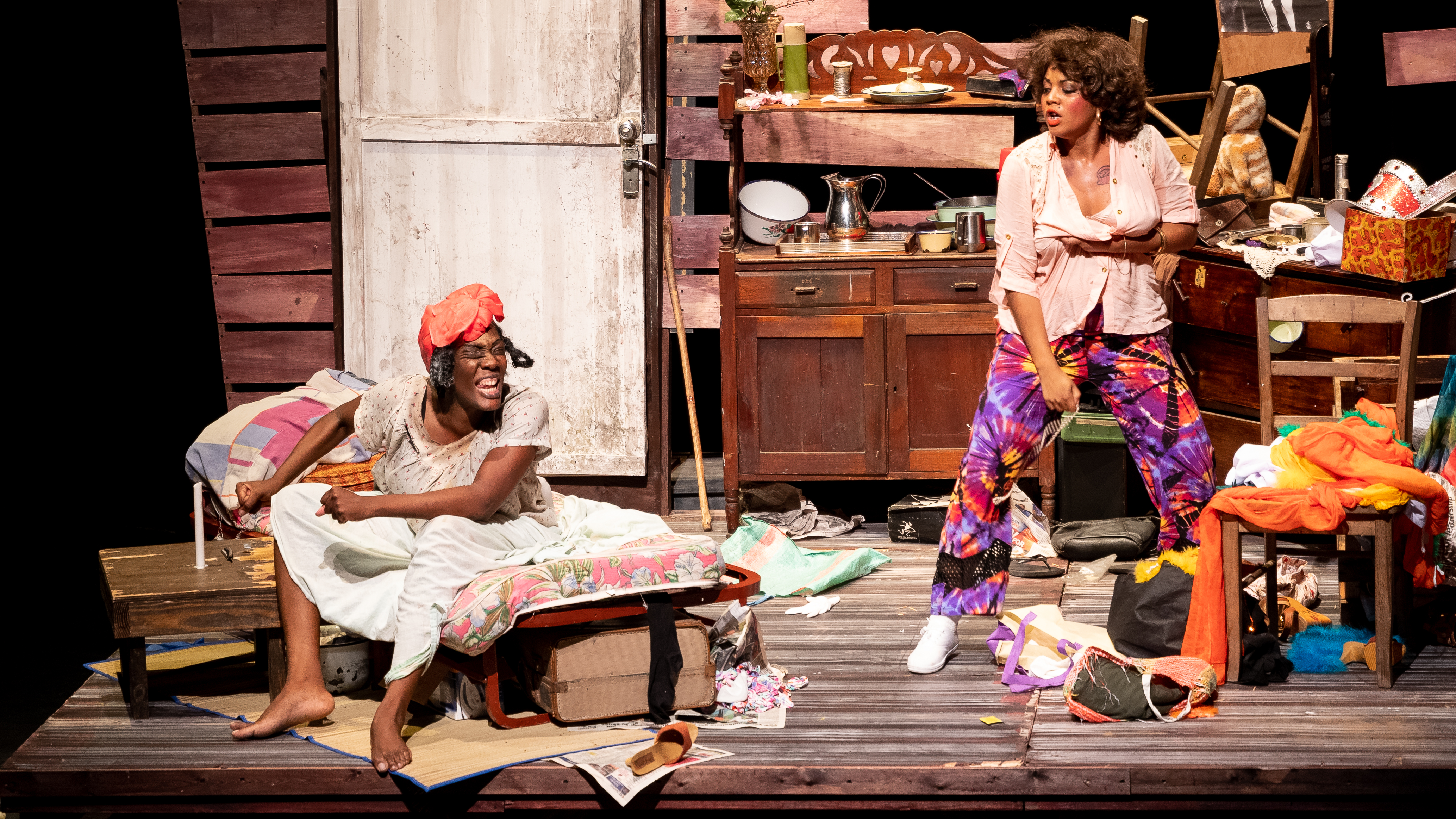
On March 31st, The National Theatre Arts Company of Trinidad and Tobago (NTACTT) presented their iteration of Hall’s classic production at Queen’s Hall, Port of Spain. The title of the play and its main characters are the namesake of Calypso King – The Mighty Sparrow’s 1956 song “Jean and Dinah,” which offered a male perspective of the predicament of sex workers after the closing of American military bases in Trinidad post World War II. The plot alternates between a post colonial/pre independent Trinidad and the ‘present’ (90s), as both women reminisced and struggled to come to terms with the consequences of their former lives and the reality of their present.
Originally written, and traditionally staged as a two-hander, Artistic Director Belinda Barnes reimagined the timeless work to include all the members of the NTACTT. The production opened on Jean’s (Ruby Parris) annual visit to Dinah (Chanel Quesnel) on J’ouvert morning as per their tradition for the past forty years. A near blind Dinah vehemently refused to leave the sanctity of her bed for the revelry, which resulted in a deeply emotional exchange of memories the duo shared over the decades. Barnes’ expansion of the cast allowed for these memories to be materialized from the pair’s decaying minds as younger versions of Jean (Shivonne Churche-Isaacs), Dinah (Syntyche Bishop) and those instrumental in their past are breathed to life.
Past and present counterparts of Jean and Dinah simultaneously commanded the stage, resulting in a temporal, theatrical masterpiece that was undeniably impactful, evocative and technically sound. The bittersweet recounting of each tale left the tattered lips of the present and physically manifested, as the veil between time was warped. One cannot help but draw the parallel between the merging and mingling of time and the degraded mental state of the older Jean and Dinah. The stage became an immersive dive into the past, minds and traumas of both women. In doing this, fundamental experiences and their effects were intensified. (TW: sexual abuse) Take the instance where teenage Jean was brutally sexually assaulted by her uncle or Dinah’s transition from waitress, to stripper, to prostitute; the audience was able to witness first-hand the exact moment their innocence was snatched and the first crack of the ultimately tattered individuals. It effectively fostered an emphatic and sympathetic bond far greater than any re-telling could do.
But victims cannot exist without their perpetrators, and so, we must address the role of men and the shortcomings of society. Hall’s “Jean and Dinah” presented the female perspective to Sparrow’s musical account, unapologetically highlighting the rampant misogyny of the 1950s. At the hands of men, the pair faced sexual, emotional, physical and verbal abuse. In every aspect of their life, they were at the mercy of men – men that abused this position. They were left without a system of support as seen during Jean’s hospital visit and the resulting subpar care she received. Their fragility juxtaposed as they were women hardened by the hardships of life, a cycle that continued as ailing Dinah was left unsupported by her children. But this is not characteristic to the 50s solely. It is an unfortunate reality of many women, young and old, in today’s society; and it is because of this truth that the timeless nature of this work is derived.
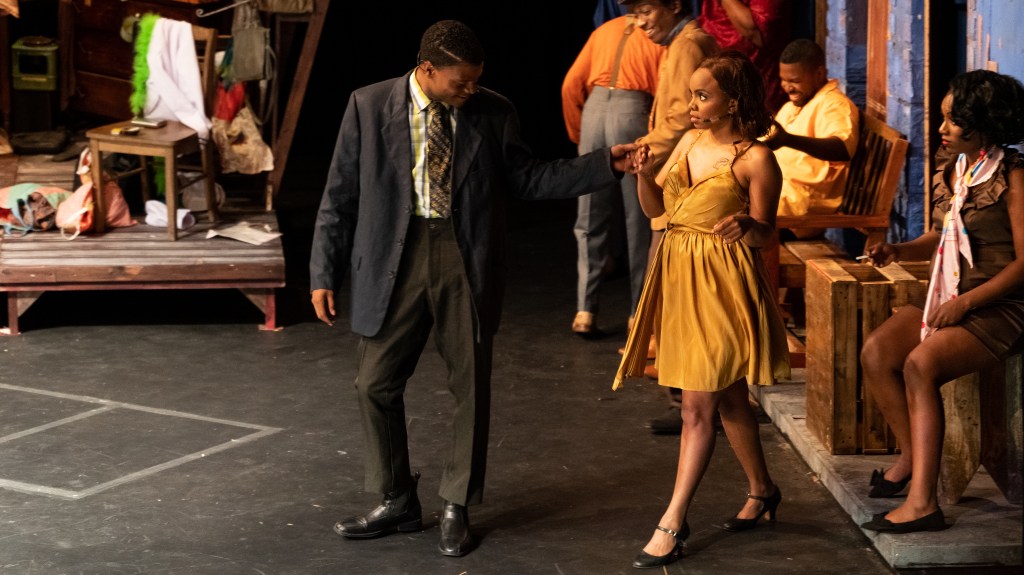
Scenes from NTACTT’s production of Tony Hall’s Jean and Dinah | Photo Credit: Saul Ramlal 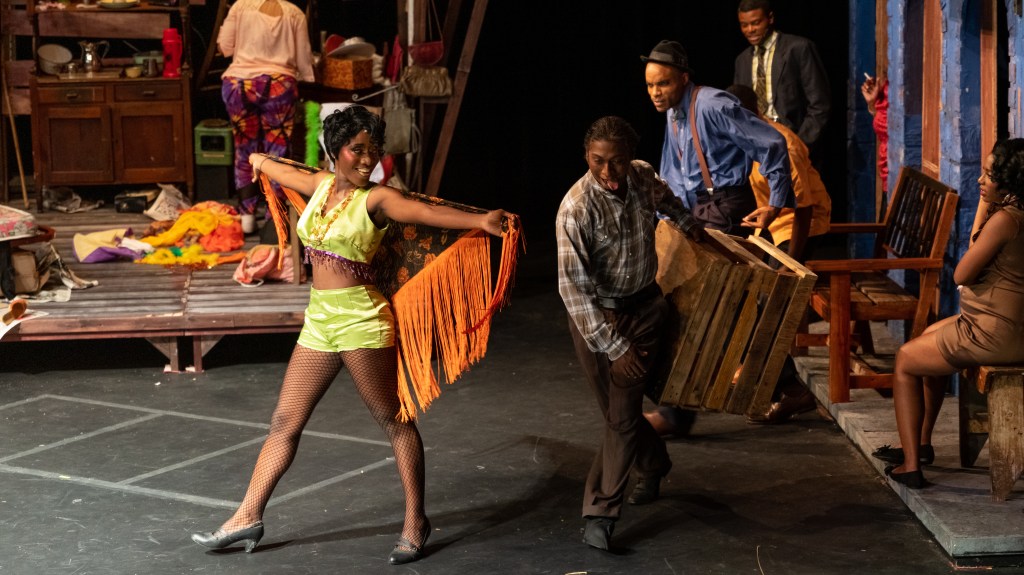
Scenes from NTACTT’s production of Tony Hall’s Jean and Dinah | Photo Credit: Saul Ramlal 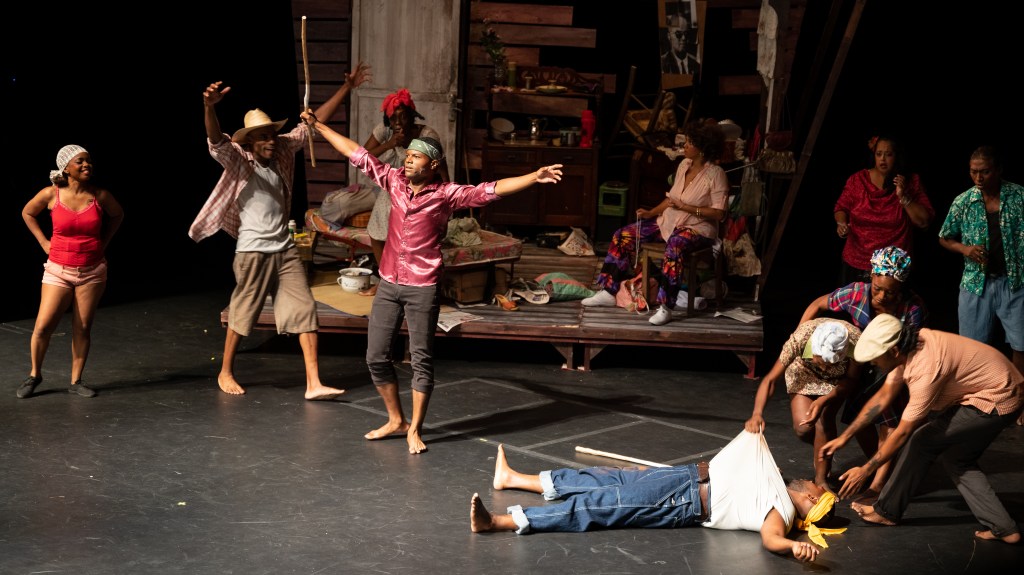
Scenes from NTACTT’s production of Tony Hall’s Jean and Dinah | Photo Credit: Saul Ramlal 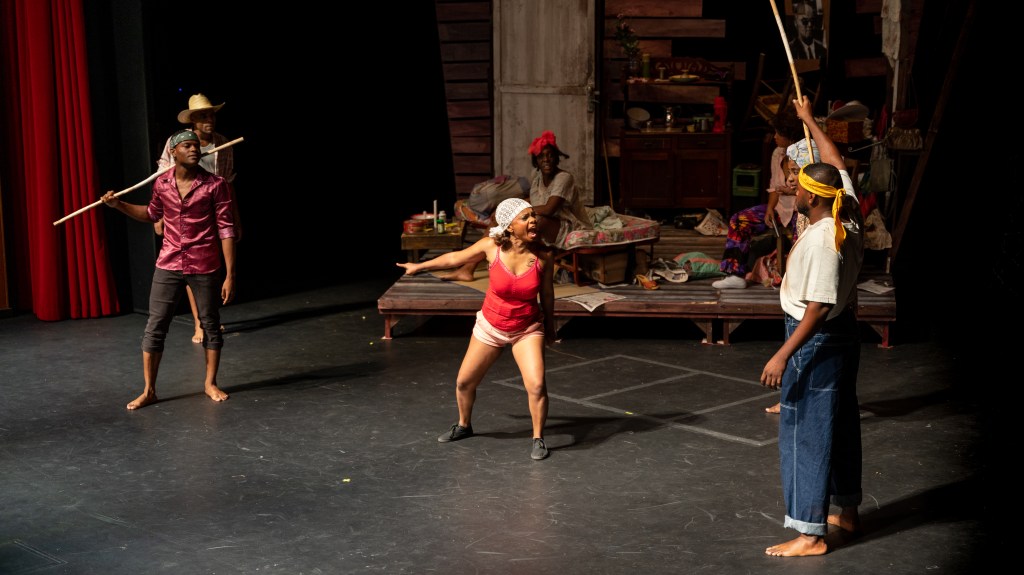
Scenes from NTACTT’s production of Tony Hall’s Jean and Dinah | Photo Credit: Saul Ramlal
“Jean and Dinah” undoubtedly explores heavy themes and dialogue that can only be effectively delivered by refined, polished acting. Ruby Parris and Chanel Quesnel deserve all their flowers. I sat on the edge of my seat, much like the rest of the audience as they heart wrenchingly and hesitantly clawed back the layers of trauma and grief. Each passing minute pushed the audience further into uncomfortability, with a believability that evoked primal sorrow. Almost as a reflection of the cyclical nature of the narrative, the heaviness is peppered by unadulterated comedy, no doubt a trauma response, and left onlookers ready to be victims to the cycle again. Not to be outdone, Syntyche Bishop and Shivonne Churche-Isaacs embodied a youthful essence, fabricating characters whose likeability and playfulness only heightened the latter feelings of guilt, grief and pity. Though the rest of the NTACTT cast played minor roles, they each provided an individual color that helped paint a full picture.
It is worth nothing, that although the marketing material clearly indicated that this production was for adults only, it is my firm belief that any form of entertainment that choses to depict sexual assault in the manner that it did, should be more mindful to include a more specific content warning (eg: Jean and Dinah explores themes and contains explicit depictions of sexual assault and domestic violence. Viewer discretion is advised), in its publicity material. I admittedly found myself physically recoiling at some of the scenes. While theatre should illicit an emotional response from the audience, it should not be one that is potentially detrimental to one’s mental wellbeing. If this material is to highlight layers of systematic abuse and lack of support systems, should it not start with basic sensitivities? But I digress.
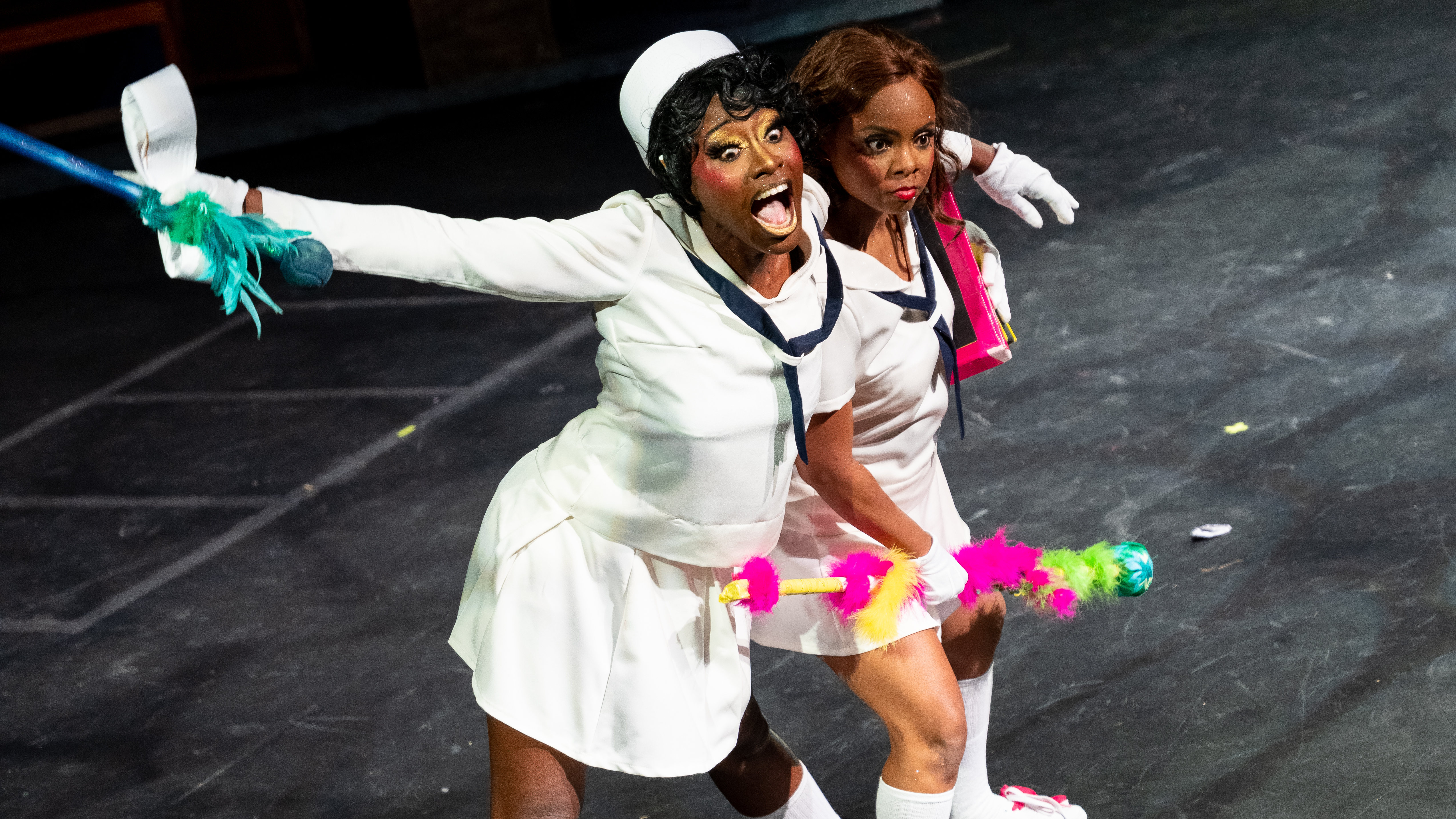
As the narrative of Jean and Dinah is heavily centered around Carnival and its festivities, one cannot explore the depths of Tony Hall’s work without touching on his Jouvay Popular Theatre Process (JPTP) (Bear with me, I have a point.) Essentially, it asks actors to identify with the archetype within themselves from the plethora of traditional Carnival characters. The theory encourages actors to allow their chosen character to become a guiding spirit of sorts. Think [of] taking on the characteristics of your chosen character. This direct symbolic correlation was apparent in various instances. We witnessed a young Dinah fearlessly assume the mantle of Bois Woman as she is forced to literally fight to survive. The second act took us to the 50s where the duo were dressed as Fancy Sailors – a period in their lives of reckless and wanton abandonment. Their staggered, almost intoxicated sailor walk and merriment eventually ending in chaos as Dinah is accidentally blinded. There is also the instance where Jean is transformed by the nurse in the hospital into a Baby Doll, engaging with members of the audience in an attempt to fill the fatherless void in her child’s life. This technique is efficiently used to highlight and emphasize the different iterations of Jean and Dinah. The audience is given the opportunity to grow with them at different stages in their lives, as the characters are granted the chance to reveal the inner parts of their true selves while, sometimes literally, wearing a mask. Mas ah make yuh out!
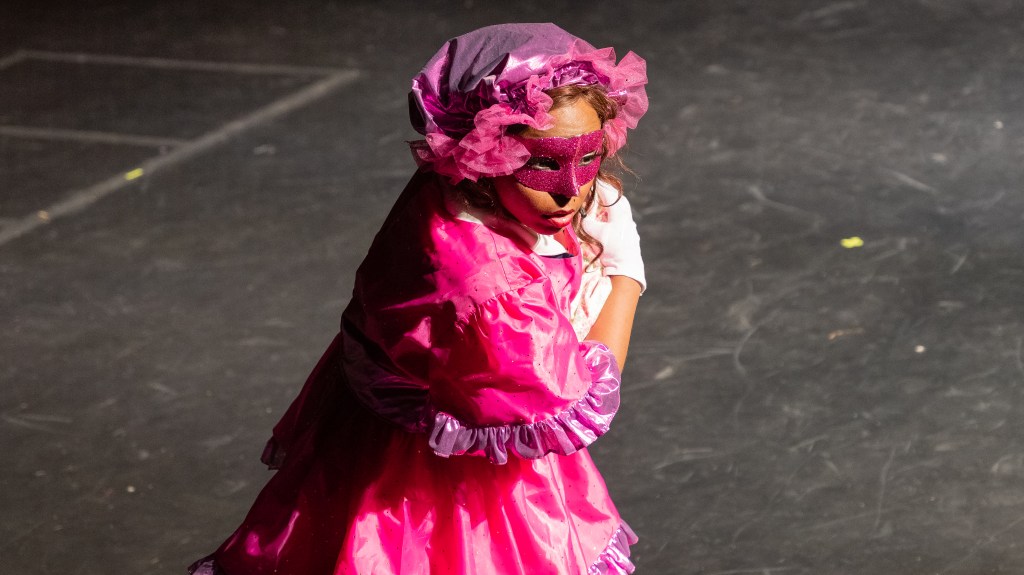
Young Jean is transformed by the nurse in the hospital into a Baby Doll | Photo Credit: Saul Ramlal 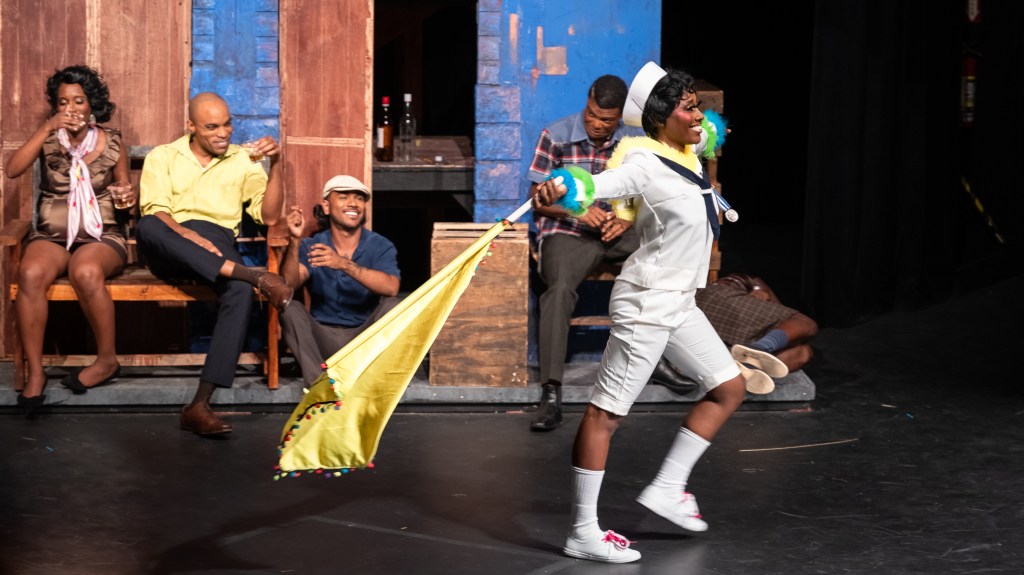
“…a period in their lives of reckless and wanton abandonment” | Photo Credit: Saul Ramlal 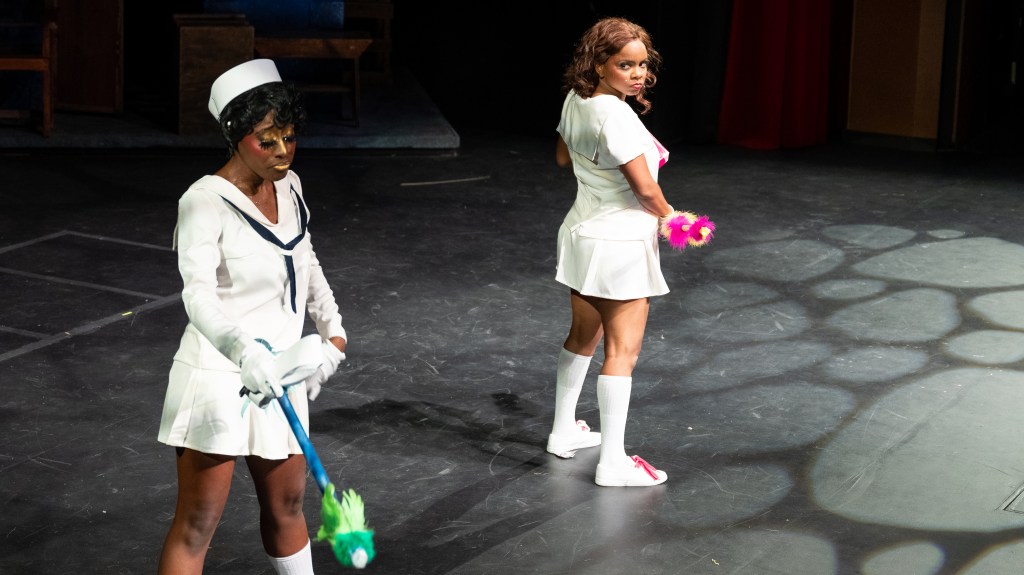
The duo (Young Jean and Dinah) dressed as Fancy Sailors | Photo Credit: Saul Ramlal 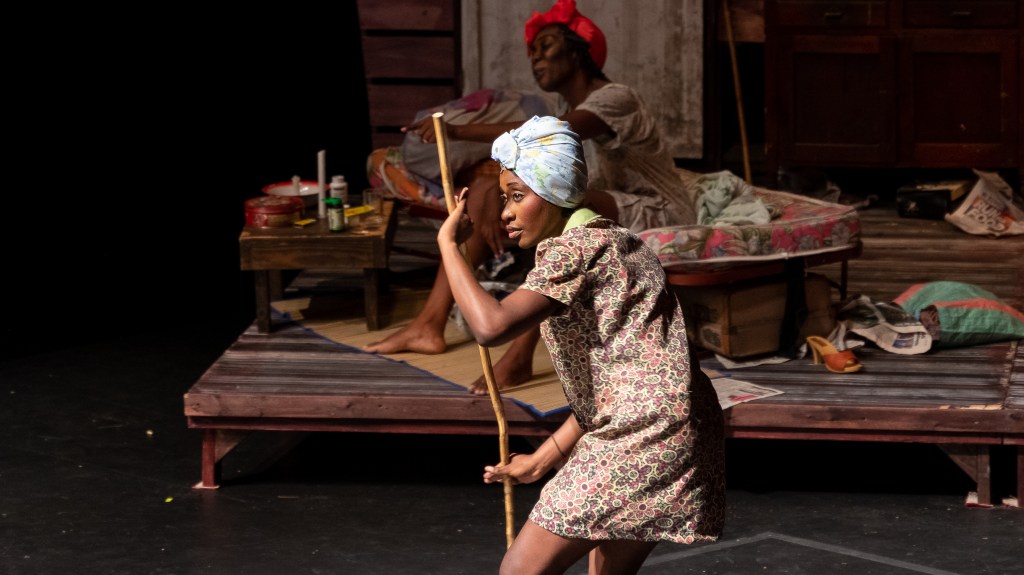
Young Dinah (Syntyche Bishop) fearlessly assume the mantle of Bois Woman | Photo Credit: Saul Ramlal
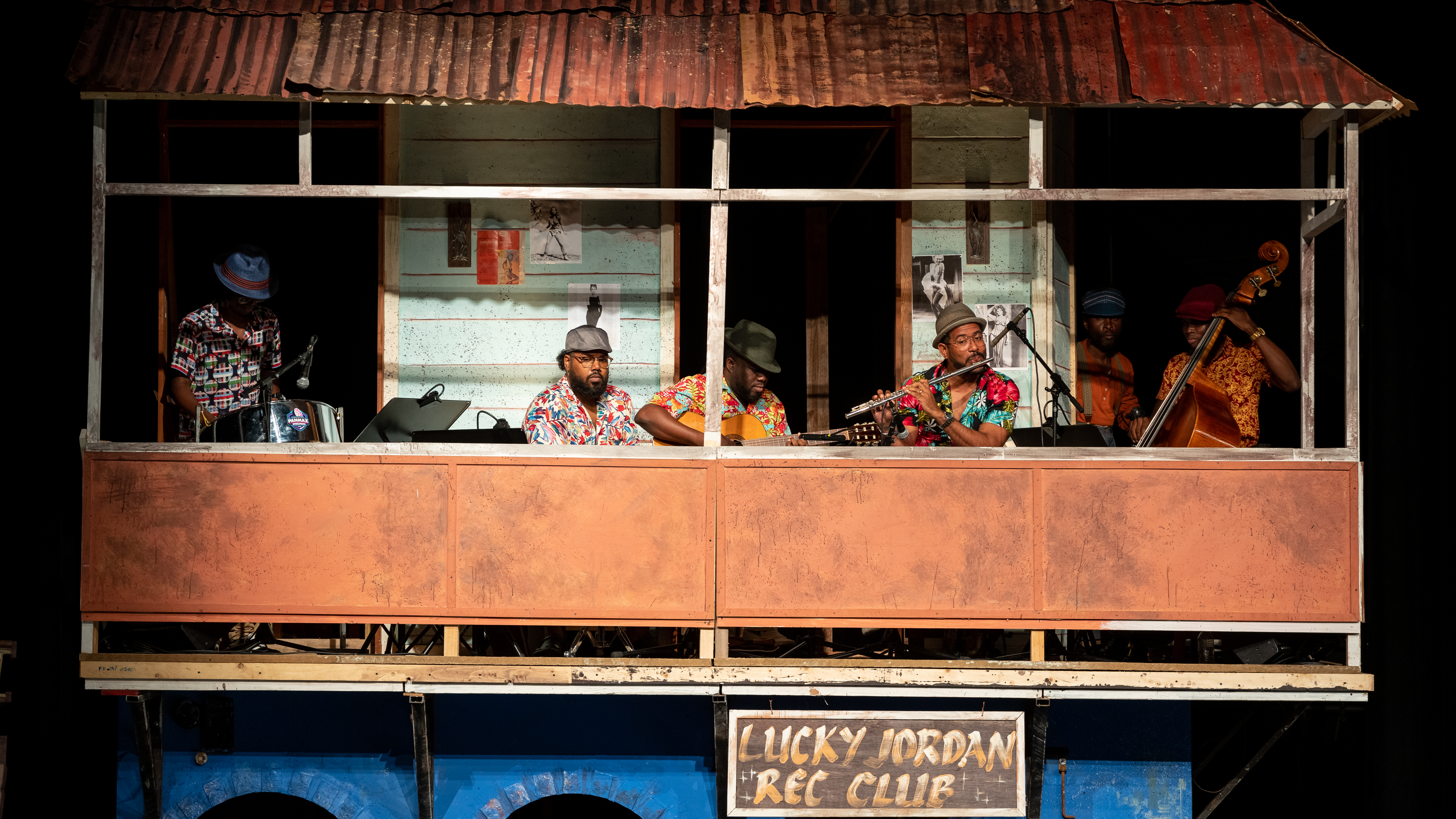
But how does one effectively play with time? It all comes down to the technical aspects. The set design by Narad Mahabir was simply striking. The stage of Queen’s Hall split down the middle; on one half rests Dinah’s lifeless, broken and disheveled bedroom representing the present whereas its past counterpart was represented by the Lucky Jordan Rec Club – a vibrant hub buzzing with life, resembling the quaint post colonial structures existing in present day downtown. We immediately understand their desire to live in the past. As symbolized by Dinah’s blindness and Jean’s damaged hand, they are quite literally broken and there is no future for them in the present. This deliberate juxtaposition of setting, supported by lighting allowed for the seamless temporal transitions. The use of costume was also brilliant. Not only were they period appropriate, they served as more than clothing. With a production that is heavily symbolic, each article of clothing helped in the telling of the narrative and set the tone of the scene. Certainly not to be overlooked was the live band of musicians that were housed on the top floor of the Recreation Club. Musicians Mark Haynes, Anthony Woodroffe Jr., Rene Aleong and Hanif Goodridge transported onlookers through time by way of music.
Tony Hall’s “Jean and Dinah” is unquestionably one of the richest pieces of West Indian literature. Much like its calypso counterpart, the material is social commentary. It weaves the complex web of the abuse, trauma and poverty that women continue to face, and offers a thought provoking critique on how colonialism has shaped gender relations in an authentically Trinidadian voice. The material forces us, the audience, to face this bitter truth. While decades have passed and there has been significant progress, we must not allow another Jean or Dinah to slip through the cracks.
Belinda Barnes and The National Theatre Arts Company’s presentation of “Jean and Dinah” was overall deeply enjoyable and breathed new life into a cultural masterpiece, while maintaining the essence of Tony Hall’s vision.
Note: Reviews are editorially independent and reflect the informed perspective of the assigned writer. Submissions may be edited for clarity, coherence, and publication standards without altering the reviewer’s original viewpoint.
Editor’s Note: If you or someone you know has been affected by sexual assault, tell a trusted friend, and reach out to the following resources:
- TTPS Gender-Based Violence Unit: 999
- Rape Crisis Society: (868) 622-7273 or WhatsApp (868) 346-2637
- Queen’s Park Counselling Center And Clinic: (868) 625-2944 /(868)-625-2556 [North] OR (868)-652-8371 [South] for STI and HIV/AIDS testing and treatment.
Remember healing is possible. You are not alone, and there are dedicated professionals ready to listen, support, and guide you on your journey toward healing and recovery.
ABOUT THE AUTHOR

Hi! I’m Anil and I wear many hats: entrepreneur, digital story-teller, content creator and Casting Executive with the T&T Performing Arts Network to name a few. My fascination with written text and it’s evocative nature began as a teen, and eventually led me to pursue a B.A in Literature and Linguistics with a minor in Education at The University of the West Indies.
While I am a full time Cake Artist, the Arts will always be my first passion. I’ve been fortunate enough recently to delve into the magical realm of theatre and share my experiences with others. When I’m not grinding I’m often found on some adventure near or far, or tucked away in a cozy coffeeshop buried in a book, updating my blog – Knock About Trini, or trying to become a self taught badass polyglot.


One comment